japonisme

11 June 2012

Jellicle Cats come out tonight

THE SONG OF THE JELLICLES

Jellicle Cats come out tonight
Jellicle Cats come one come all:
The Jellicle Moon is shining bright—
Jellicles come to the Jellicle Ball.

Jellicle Cats are black and white,
Jellicle Cats are rather small;
Jellicle Cats are merry and bright,
And pleasant to hear when they caterwaul.
Jellicle Cats have cheerful faces,
Jellicle Cats have bright black eyes;
They like to practise their airs and graces
And wait for the Jellicle Moon to rise.

Jellicle Cats develop slowly,
Jellicle Cats are not too big;
Jellicle Cats are roly-poly,
They know how to dance a gavotte
and a jig.
Until the Jellicle Moon appears
They make their toilette and take their repose:
Jellicles wash behind their ears,
Jellicles dry between their toes.

Jellicle Cats are white and black,
Jellicle Cats are of
moderate size;
Jellicles jump like a jumping-jack,
Jellicle Cats have moonlit eyes.
They're quiet enough in the morning hours,
They're quiet enough
in the afternoon,
Reserving their
terpsichorean powers
To dance by the light of
the Jellicle Moon.

Jellicle Cats are black and white,
Jellicle Cats (as I said) are small;
If it happens to be a stormy night
They will practise a caper or two in the hall.
If it happens the sun is shining bright
You would say they had nothing to do at all:
They are resting and saving themselves to be right
For the Jellicle Moon and the Jellicle Ball.

T. S. (Thomas Stearns) Eliot

Labels: , , , , , , , ,

28 July 2011

Verborgene Impressionen : Hidden Impressions

these images and the comments below are from the exhibition and catalogue of the same name as this post, held in vienna in the spring of 1990. again, we can see how the perspective and the artwork itself changes from country to country.

[commercial trade between austria and japan did not begin until 1869, as no treaties had yet been signed. at last the ships from austria were in japanese waters, and mercantile interests were being pursued.]

Art was included in their planning only to a minor extent -- at first. Export, import, commercial profits in the account-books, that was the motto. However, through its industrial products and handicrafts, Japan, only just linked to world trade connections, provided this very thing -- art, and did so in a fascinating way. In massive numbers and for prices that were as unprecedented as they were horrendous, china, lacquered works, bronzes, silk, all sorts of dyed textiles and other handicrafts were leaving the country en masse.

In a remarkably short time discriminating connoisseurs and artists in the west discovered in an art which up until now had been practically inaccessible, an expression of bourgeois culture that was comparable to theirs, highly cultivated, and refined, one that would maintain the search for new means of artistic expression, and, even more important, enrich it. "In every field", summarised the preface to the catalogue of the great Japanese exhibition in the Vienna Secession in the year 1900 "new experiments were taking place, a searching and feeling for new means of expression, which nature was not going to render simply by a naive enjoyment of the world of appearances.

The intention to simplify, to find the quintessence of things became the criterion. The pioneers of art were searching for models they could build on, that they could develop within themselves. They found what they were looking for in the age-old culture of the East, in the art of the Japanese." "Japonisme", as it was called, meaning the sum total of all the very varied influences of Japanese style, moved in to conquer western creativity and sensibility.

First of all it overtook western Europe and then, after a certain lapse of time, moved from there to central and eastern Europe as well. In its more narrow sense Japonisme is a phenomenon that can be explained according to its own aesthetic principles; indeed, taking an example from the graphic arts or painting, this can be seen most clearly wherever the accustomed, almost mathematical exactness of perspective is sacrificed in favour of an emphasis on decorative surface. As well as this, the fact that the ornamentation can be repeated arbitrarily may well diminish individuality but the elements of timelessness and universality this adds are equally valid.

Europe discovered these principles most of all in the woodcuts and engravings, which were cheap and easy to get hold of. In spite of strict decorative composition and an equal emphasis on line, form and colour in these works the whole area of the page, whether painted on or left free was endowed with the utmost vitality. Exterior characteristics, such as the choice of extremely wide or high formats or fan-forms, which would have been incomprehensible without the Japanese were eagerly exploited by our artists as well.

This art, which had spread all over Europe, which had been welcomed mostly with exultation but also with occasional biting criticism, had become a special stylistic medium enabling it to satisfy not only the expressive needs of many artists, but also to correspond to a certain "Zeitgeist" in public taste. For Japonisme was more than just the transference of aesthetic feeling into works of art; above all it was a phenomenon in the history of intellectual development and taste.

In its broadest sense Japonisme was encountered in almost every livingroom, an exotic spice which had become an integral part of almost every area of domestic and social life, whether in the sugar and tea tins decorated with Geishas, or mocca-cups from Karlsbad and Schlak-kenwerth, who set themselves up in competition with Imari and Satsuma; from ball-dresses a la kimono to postcards with blond "musumes"; from travelogues and novels, written by more authors than one Loti, to the first collections of Japanese art in our museums; from Viennese and Budapest educated classes, the Bildungsbiirger, citizens hungry for culture, who became Japan-connoisseurs and fanatics; from artists between Bleiberg and Prague, who wanted to see Nikko and Kyoto with their own eyes, to the dozens of manufacturers who produced Nippon knick-knacks for mantlepieces and glass-cabinets.

"Japonisme" was a motley if pretty miscellany, where understanding and imagination, art and kitsch, the genuine and the pretended were often uneasy bedfellows; out of this emerged, in its own radical and independent potency, the art of the Viennese Secession, or of a Gustav Klimt, and went on to attain an overriding significance; all this came from the same soil and humus, the intensive cultivation of the fashion for things Japanese.

Peter Pantzer, Österreichisches Museum für Angewandte Kunst - 1990

Labels: , , , , , , , ,

02 July 2011

firebird


FLAMINGO WATCHING

Wherever the flamingo goes,
she brings
a city’s worth
of furbelows.
She seems


unnatural by nature—
too vivid and peculiar
a structure to be pretty,


and flexible to the point
of oddity. Perched on


those legs,
anything she does
seems like an act. Descending
on her egg or
draping her head


along her back, she’s
too exact and sinuous


to convince an audience
she’s serious.
The natural elect,
they think,
would be less pink,


less able to relax
their necks,
less flamboyant
in general.
They privately expect
that it’s some


poorly jointed bland
grey animal
with mitts for hands
whom God protects.

Kay Ryan

Kay Ryan, “Flamingo Watching” from Flamingo Watching (Copper Beech Press, 1994). Copyright © 1994 by Kay Ryan.

(over to you, m. ghost)

Labels: , , , , , , , , , ,

01 March 2011

frogs sing, roosters sing

.蛙鳴き鶏なき東しらみけり
kawazu naki tori naki higashi shirami keri

frogs sing, roosters sing
the east
turns light

issa

as van gogh wrote to his brother, 'i think the drawing of the blade of glass and the carnation and the hokusai in *bing's reproductions are admirable... isn't it almost a true religion which these simple japanese teach us, who live in nature as though they themselves were flowers.'

what van gogh probably didn't know was that in japan 'precise rules had been laid down governing the drawing of animals and plants.' through a combination of historical documents and close observation, the artists were required to produce drawings that were 'accurate enough to satisfy a zoologist,' and in doing so revealed their closeness to nature, unlike the europeans who seemed to survey it from afar. 1

the japanese portrayal of animals and plants were true to life but not naturalistic. one found in them a deeper significance, a symbolic element beyond the artistic intent. as a part of historical religions in the area every living thing was both itself, and a representation of the essence it embodied.


in japan, the cock symbolized high esteem. it is also suggested that the bird acquired a religious significance as a representative of peace and the coming of dawn.


the tale of the rooster who made the sun come up is legend; the one with which i am most familiar is the story of chanticleer and the fox, which began with chaucer if not before. two rival inflated egos at the job of trickstering each other, to both the success and the failure of each.


to my eyes, the cock's greatest conceit is his beauty. how graphically dramatic is that bright red against the black or white of the rest of the bird. even in the more multi-colored birds the comb, the tail, and the attitude delight us, and make us laugh with bit of awe.

Is that a
rooster? He
thrashes in the snow
for a grain. Finds
it. Rips
it into
flames. Flaps. Crows.
Flames
bursting out of his brow.


How many nights must it take
one such as me to learn
that we aren’t, after all, made
from that bird that flies out of its ashes,
that for us
as we go up in flames, our one work

is
to open ourselves, to be
the flames?

Galway Kinnell

from Another Night in the Ruins from Three Books. Copyright © 2002 by Galway Kinnell. All rights reserved.

* Artistic Japan

Labels: , , , , , , , , , , , , , ,

28 September 2008

swanee


I've been away from you a long time
I never thought I'd miss 'ya so
Somehow I feel, your love is real
Near you I long to be.

The Birds are sing- ing it is song-time
The banjos strummin'
soft and low
I know that you yearn for me too
swanee you're calling me
Swanee Swanee -- how I love ya,
how I love ya
My dear old swanee.
I'd give the world to be
among the folks in D-I-X-I-E-ven though

my mam- my's waiting for me,
praying for me down by the swanne.
The folks up north
will see me no more
when I go to that swanee shore
mammy, mammy
My dear old mammy
The folks up north
will see me no more
When I get to that Swanee shore
I love the old folks at home

Swanee -- how I love ya, how I love ya
My dear old swanee.
I'd give the world to be among the
folks in D-I-X-I-E-ven though

my mam- my's waiting for me,
praying for me
down by the swanee.
The folks up north will
see me no more
when I get to that swanee shore.

George Gershwin (1919)

Labels: , , , , , ,

04 October 2007

Aubade of the Singer And Saboteur, Marie Triste

In the twenties, I would visit Dachau often with my brother.
There was then an artists' colony outside the Ingolstadt Woods
And these estates had a meadow filled
With the hazy blood-campion, sumac, and delicate yellow cinquefoil.
At the left of the meadow there was a fast stream and pond, and
Along the stream, six lodges and the oak Dachau Hall where
Meals were held and the evening concerts. In winter, the Hall
Was a hostel for hunters, and the violinists, who were the first
Of the colony to arrive in spring, would spend three days
Scouring the deer blood off the floors, tables, walls, and sinks.
They would rub myrtle leaves into the wood to get out the stink!

The railway from Munich to Ingolstadt would deposit us by
The gold water tower, and my brother, Charles, and I would cut
Across two fields to the pastures behind Dachau Hall. Once,
Crossing these fields, Charles, who had been drinking warm beer
Since morning, stopped, and crouching low in the white chicory
And lupine found a single, reddish touch-me-not which is rare
Here in the mountains. A young surgeon, Charles assumed his
Condescending tone, and began by saying, "Now, sister,

This flower has no perfume --- what you smell is not your
Brother's breath either, but the yeast sheds of the brewery
just over
That hill. This uncommon flower can grow to an enormous height
If planted in water. It is a succulent annual. Its private
Appointments are oval and its nodding blossom takes its weight
From pods with crimson threadlike supports." With his bony fingers

He began to force open the flower. I blushed. He said, "It is
A devoted, sexual flower; its tough, meatlike labia protrude
Until autumn and then shrivel; this adult flower
If disturbed explodes into a small yellow rain like
That fawn we watched urinating on the hawthorn just last August."

Charles was only two years older but could be a wicked fellow.
Once, on our first day at the colony, at midnight, he was
Discovered nude and bathing in the pond with a cellist. She was
The only cellist, and for that week, Charles was their only doctor.
So neither was banished. But neither was spoken to except
For rehearsals and in illness. There is a short bridge passage
In a Scriabin sonata that reminds me of the bursting touch-me-nots,
That reminds me, also, of Heisdt-Bridge itself, in Poland! We blew
It up in October. I had primed the packages of glycerin, kieselguhr,
Woodmeal, and chalk. We curbed the explosives with sulfur.
I sat in primrose and sorrel with the plunger-box and at four o'clock
Up went the munitions shipment from Munich to Warsaw. Those thin
Crimson supports of the flower tossed up like the sunburned arms
Of the pianist Mark Meichnik, arriving at his favorite E-flat-
Major chord; and I guess that whenever a train or warehouse went
Four-ways-to-market right before my eyes, I thought
Of that large moment of Schumann's. The morning
After Heidst-Bridge I was captured and Charles

Was shot.

I was at Dachau by the weekend. They have kept me in
A small cell. A young lieutenant tortured me that first night.
Knowing I was a singer they asked me to perform
For the commandant early the next week.
By then I was able to stand again, but my Nazi inquisitor
Had for an hour touched live wires to me while holding
Me in a shallow ice bath. I had been
Made into a tenor voice! The commandant's wife dismissed me
After a few notes. As I was tortured I forced myself
To dwell on the adult life of the touch-me-not, that fawn in
Hawthorn, and my brother's drunken anatomy lesson that showed
No skill at all there in the silver meadow. I was probably
Stupid not to have fallen unconscious. When I was
Ordered out of the parlor by the Nazi bitch, I did, for the first

Time in two years, cry aloud. I think it was for my voice that
I cried so badly. The guards laughed, returning me to my cell.
My cell has a bench, a pail, and a wire brush. Every two days
Without warning the hose comes alive with water, moving through
The space like a snake.
Sometimes it wakes me about the face and legs.

I have lost so much weight that I can sleep comfortably
On the pine bench. I watch shadows in the cell become,
At night, the masquerade dance in the woodcut by Hans Burgkmair:

Its bird shapes, that procession of men threading the dance,
And Maximilian I greeting them as they twist past the banquet tables.
My inquisitor, all night in the chamber, commanding me
To sing, to sing!

When they fire the ovens out beside the pastures it is like
A giant catching his breath. And then there is the silence
Of the trucks with their murmuring engines. My delusions:
A sound like my brother's cellist, at this early hour, opening
The morning with difficult arm exercises; he said that she would
Play for him naked and until he became jealous. Then I would
Say, "Oh, Charles!" He'd laugh.

My favorite pastime has become the imaginary destruction of flowers.
I hear their screams. They bleed onto the floor of my cell. I scrub
The wall where a Bürgermeister opened the artery of a doe that
He had shot just outside the window.
Later, the Bürgermeister favorite butcher making venison flanks
Into roasts, how he sawed at the large femur of the deer
Like the cellist waking with her instrument, their right arms
Are beautiful with white muscles;
The butcher and the cellist died, here, admiring the noxious
Blue crystals on the floors of the gas chamber: the way,
At first, they darken to indigo and like smoke
Climb over your ankles, reaching your waist ---
You fall naked as into the field that is with a breeze turning
All its wildflowers, bladder-campion and myrtle, into
A melody of just three staves written for four voices:

Slaughter and music.
Two of the old miracles. They were not my choices.

--- From The Mercy Seat
Norman Dubiefont
©2001 Copper Canyon Press


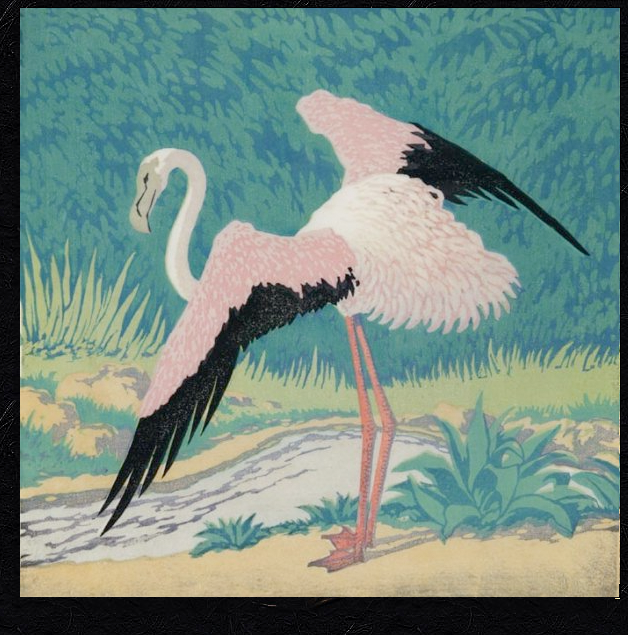
By the end of the 19th century and the beginning of the 20th century, Dachau, alongside Worpswede, was one of Europe's most important artists' villages. At that time it was said that every tenth person in Dachau was an artist and this included famous names such as Adolf Hölzel, Ludwig Dill and Arthur Langhammer. Carl Spitzweg and Lovis Corinth were among those who repeatedly came to Dachau hoping to capture the special quality of light of the Dachau fens in their open-air paintings. Carl Thiemann was a student at the Academy of Fine Arts in Prague from 1905. To begin with he was engrossed with etching, but became increasingly fascinated by coloured wood cuts soon becoming a member of the leading group of modern wood engravers. Thiemann, who came to Dachau in 1908, was the last to build a house in the artists’ colony. His was the only one surrounded by a large garden.

Thiemann stayed in Dachau until he died in 1966. His best and most poular works are his woodcuts. They are cut and hand-printed with great precision and display resourcefulness in their use of colour. Theimann's themes and methods came to be modeled more and more after the Japanese prints he became exposed to. He even took to signing his pieces with the same kind of modified chop that many of his fellow printmakers of the time were using.

Labels: , ,

older posts